November 6, 2022

Buddhism Amidst Redwoods


The Saratoga Gap is a mountain pass that has been used since the late 19th century to cross over the Santa Cruz mountains. The logging trail that descended from the crest of the mountains down to the towns of Saratoga and San Jose bearing redwood-laden wagons, is now a winding tar ribbon with aggressively banked curves, separated by short straights, that could put up g-forces normally found only on the racetrack. No surprise that on weekends, the mountains reverberate with the throaty roars of exotic sports cars and the banshee screams of barely street-legal motorcycles, as they pass brave bicyclists riding punishingly uphill for miles.

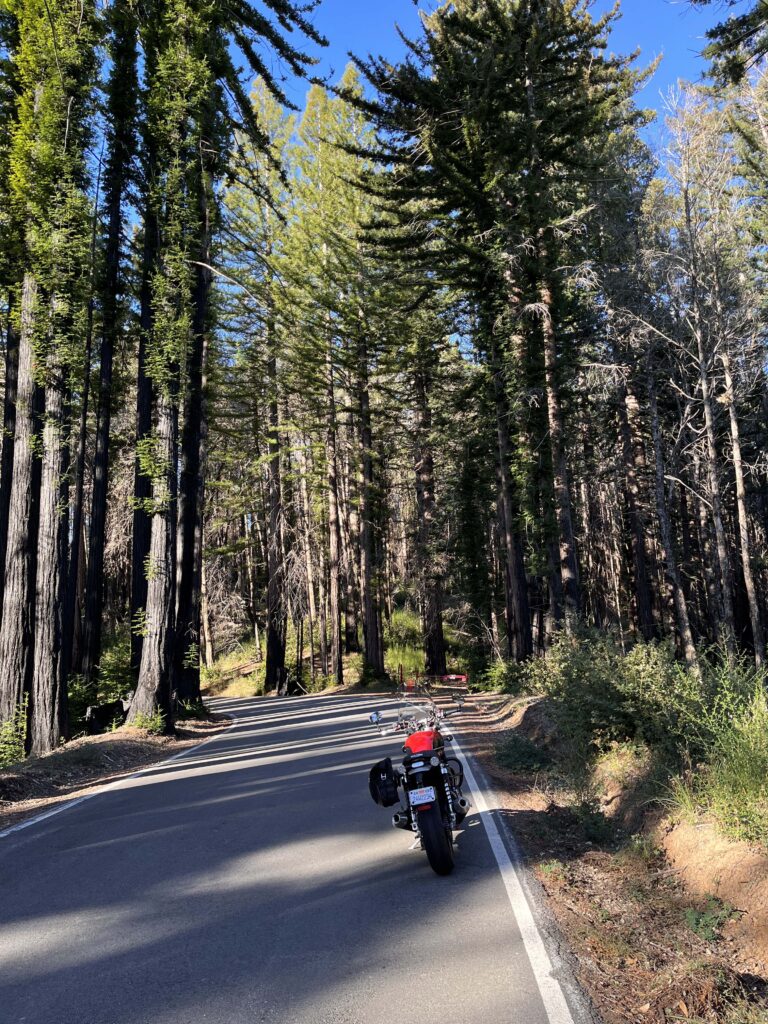
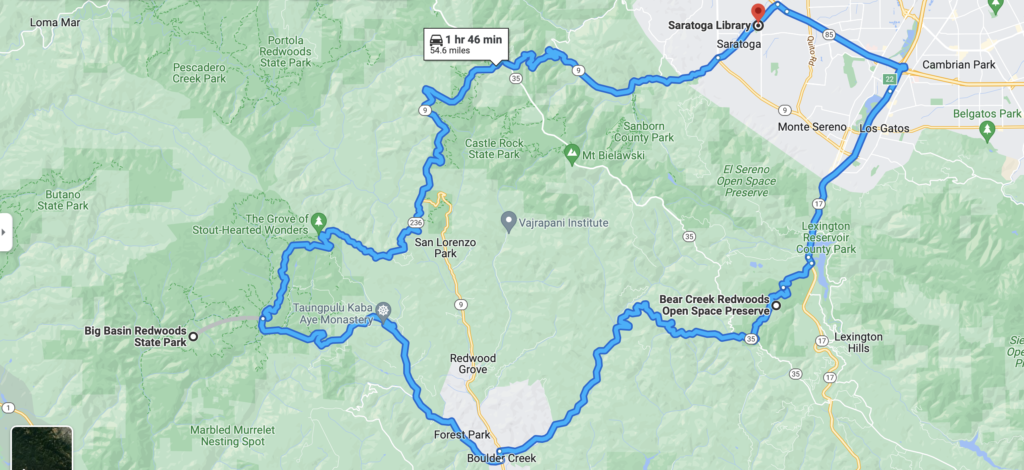
On an early Saturday morning, I reach the rim of the gap and ride on ahead onto Big Basin Way. Many miles later, I approach the junction where the road ahead had been closed for over two years to repair the devastation wreaked by the fire of 2020 upon the towering redwoods of the Big Basin State Park. That road-closed sign is gone today, so I continue straight ahead to visit the park through miles of tight curves—or twisties, as bikers like to call them.

Cars endure curves. Motorcycles crave them.

There’s damage everywhere—charred, browned, and stunted trees, amongst green ones—creating arid brown vistas in large sections that were verdant green. Some of these giants had lasted a thousand or more years of drought and fire, only to succumb to this one. I reach the state park without passing a single other vehicle and roll into the parking lot. A ranger sits disinterestedly in his cabin and I park the bike to take a stroll.

Walking around in protective motorcycle gear with a backpack and a helmet must be the closest modern approximation to a medieval knight in chainmail armor. Nothing is ever comfortable. Things conspire to poke you in unexpected places. You’re never sure if you’ll be around long enough, off the bike, to make it worth your while to pop off your lid.

If you do take off your helmet, you must cart it around until you can put it back on. If you leave it on, you feel about as out of place as a scuba diver at a nudist convention. Even if you attract any conversation, your ear-plugs will dutifully muffle it. You get unknowingly hotter, like that frog in the boiling water experiment. You want to scratch yourself in exactly the places where you cannot. To pee is no longer an urge, but a calculated deliberation. I do sometimes wonder if the ride is worth all this punishment.

But all this has given me new admiration for the knight in his pointy gear—the lance, the sword, the visor… the boot tips. How ever did he stumble through life without harrowingly poking his wretched groin?

But at least a knight had a squire. I don’t. I would have commissioned mine to help me off the bike, hold my helmet, and wheel the heavy bike into and out of parking spots. Perhaps he could even have cleaned and greased the drive chain, given his way with the metal stuff. Or brought me a hot masala chai and two pointy samosas.

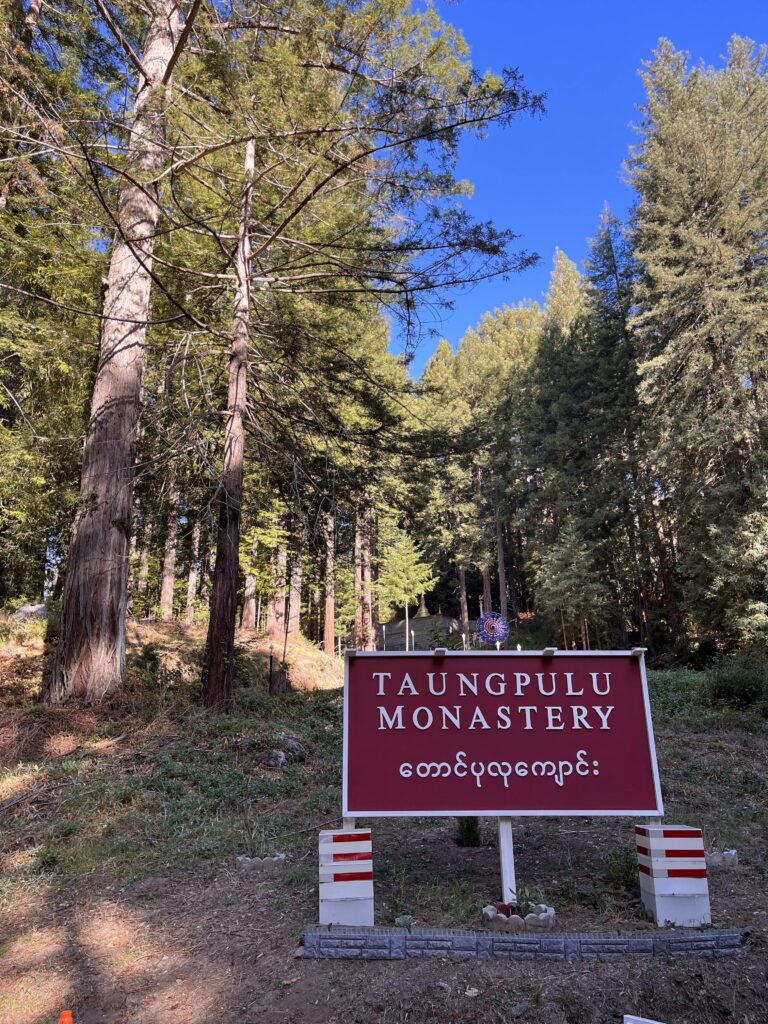
I get back on the bike and ride past the park. Dangling limbs of dead trees gesticulate awkwardly in the sun. I ride for about half an hour until an intriguing roadway sign forces a stop. I park and see a hand-painted sign pointing to Pagoda and another to Monastery

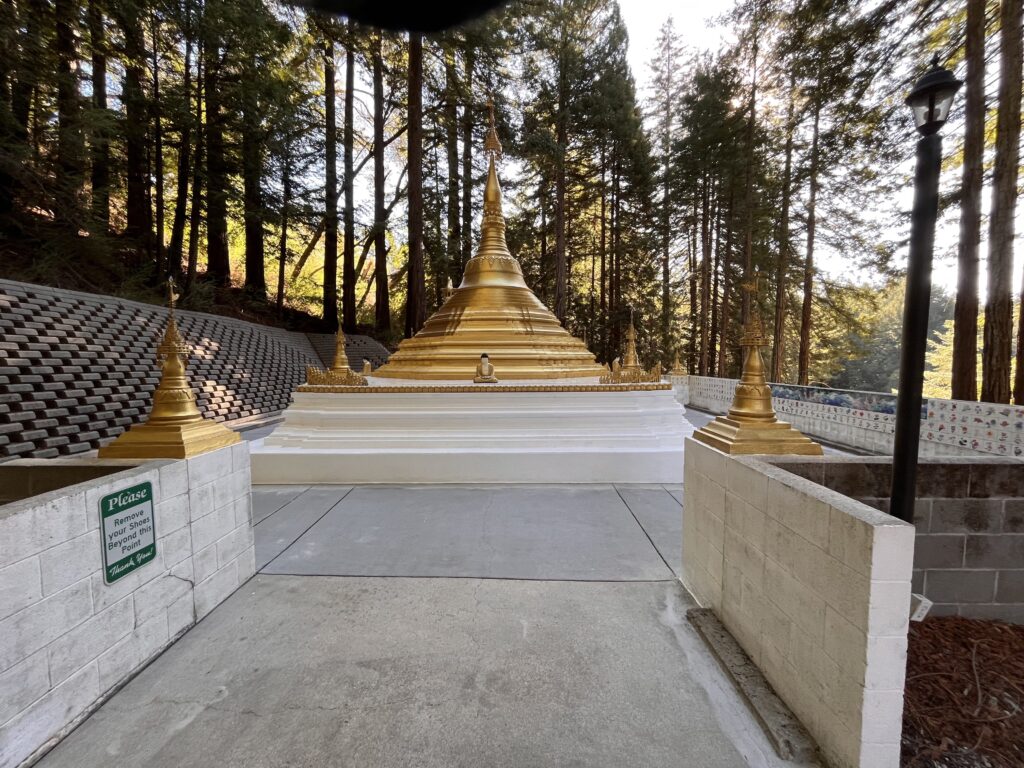
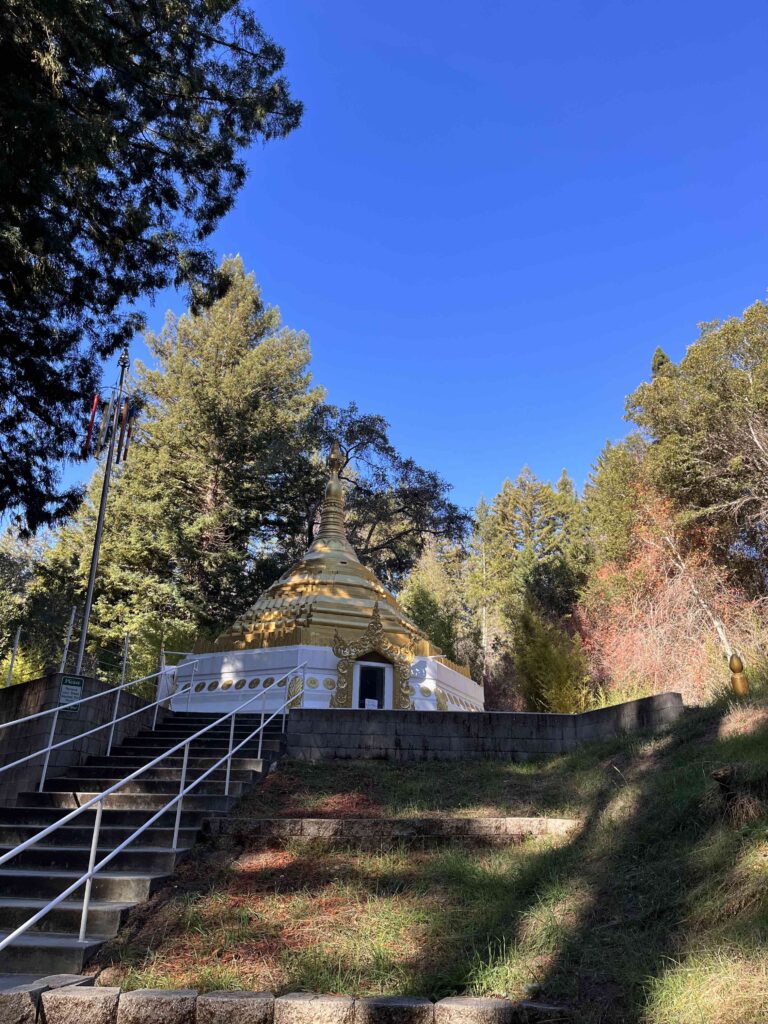
I’m at a monastery that was started by Taungpulu Sayadaw, a renowned Burmese forest monk of the most ancient Theravada tradition of Buddhism. There isn’t a soul anywhere. Perhaps they’ve been given up to Zoom. I leave the bike below and trudge up to the golden pagoda that looks lonely amidst the redwoods towering around it. Across the way, I see the monastery that’s supposed to hold a body relic of the venerable monk.

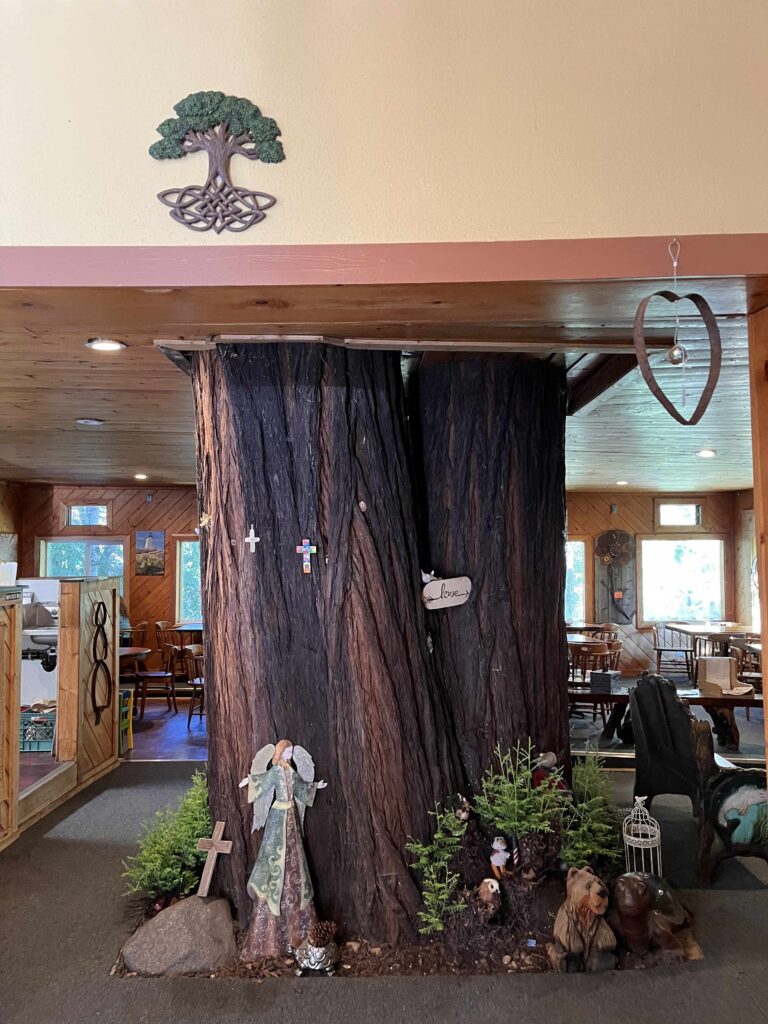
The road ends at Boulder Creek and I stop at the Tree House Cafe and put in for a coffee and a vege-burrito. The cafe is quirky and family-run and I notice how a massive redwood tree growing right through the roof has given the place its name. A pleasant girl at the counter takes my order, pronouncing my name perfectly. Turns out she has a friend with the same name.

I pick up the coffee and see an older woman sitting alone at a window table, lit brightly by the slanting rays of the morning sun. I ask to join her and she happily waves me in. We start up a conversation that would take up the next ninety minutes and last multiple rounds of coffee, meandering through children, grandchildren, mental health, spousal relationships, Mexico, Spain (she had a parent from each country), and the slumping real estate market. It’s amazing how strangers will divulge their personal stories and this always restores in me a fundamental faith in mankind.

Donning my gear again, I ride along Bear Creek Road and stop at a few interesting places where the sun trickles past the canopy to light up the forest floor in bright patches. I stop at the Bear Creek Nature Preserve about a dozen miles away that opened to the public a mere three years ago.

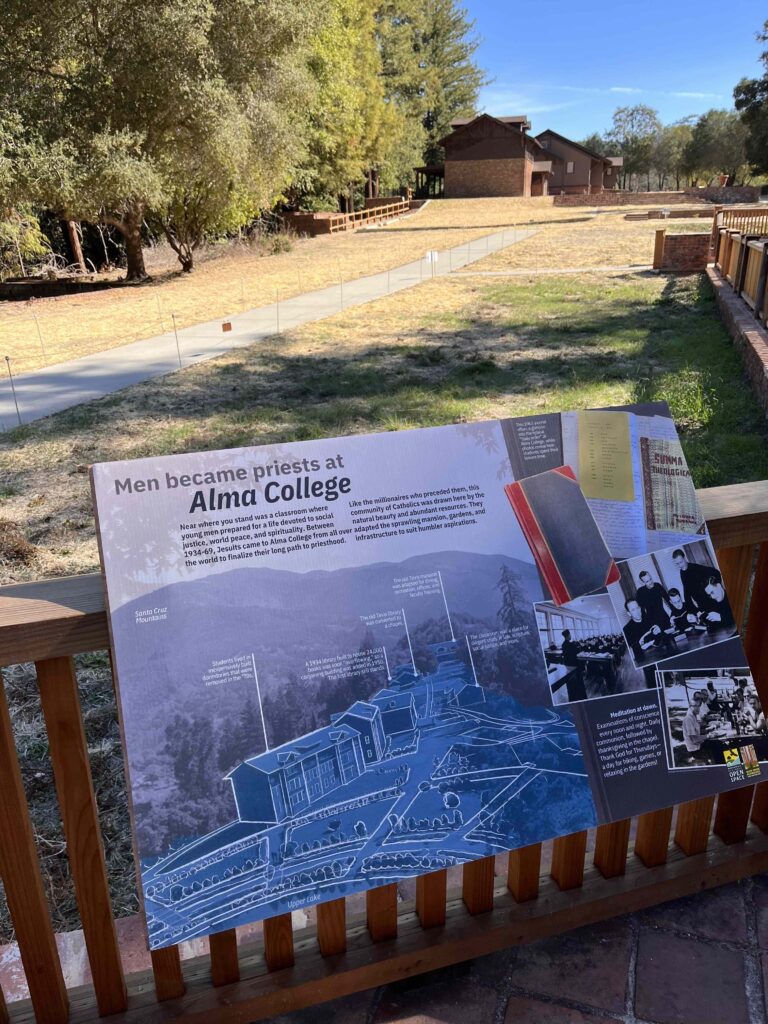
Across from the parking lot are the ruins of Alma College—one of only two Jesuit seminaries in the country—that was shut down in the late 1960s after decades of operation. I walk over to take a look at the buildings of the same theological order that founded my own high school in the mid 19th century, more than 10,000 miles away in Bangalore. I owe much of my foundational education to the tireless Jesuit fathers whose pedagogical methods included writing, memorization, and generous use of the wooden cane.

I wonder how my kids today would accept the profound explanation we were offered: Spare the rod and spoil the child.

I join Highway 17 and head towards Los Gatos. Unlike most exit ramps, the one for downtown Las Gatos is a straight one that comes up abruptly on the left. A motorist must exit here at high speed, yet slow down rapidly and sufficiently before they hit the first light at the heart of downtown to stop inches away from the unwary mom languidly pushing her stroller across the crosswalk. I downshift rapidly and perhaps too aggressively, for the bike shudders a bit but stays on course. For this dose of stability, I owe thanks to the slipper clutch.

A motorcycle clutch is a mechanical device that allows a running engine to be decoupled from the drive wheel—the rear one. You need this for a number of reasons, not the least of which is to be able to stop at a light, and if you were Peter Fonda, coolly smoke a cigarette while you waited. The clutch connects the engine, the drivetrain, and the rear wheel in a tight linkage that must be broken from time to time to get things done. An engaged clutch will disengage the engine, allowing it to spin freely and independently from the rear wheel, as during a gear change or at a light.

When a motorcycle is downshifted, the inertia of the rear wheel turns it faster than the engine, which is braking rapidly. By letting the clutch out slowly, the rider allows the clutch plates to slip against one another, so the extra momentum of the rear wheel is dissipated as friction at the clutch.

When a motorcycle is rapidly downshifted through multiple gears, the momentum of the rear wheel cannot find sufficient opposition from the clutch. Yet it must obey Sir Isaac Newton and find a way to dissipate that extra momentum. The easiest way out is for the wheel to lock up and slide out, causing what bikers call a lowside crash. A slipper clutch detects this back momentum and allows the clutch to automatically slip, without rider intervention, so the slack is taken up at the clutch rather than being forced at the wheel.

Technology wins and keeps the imprudent rider from parting with the bike.

As I head home, I see an older gentleman walking along with a grocery bag under each arm. I recognize him as my neighbor, but I can’t really stop the motorcycle and offer to pick him up, or his bags. I notice his car on the street when I get back and it hits me right then that Orthodox Jewish families don’t drive cars on Saturday, the Shabbat. I’ve lived across them for years and I can’t believe that I’ve never observed this until now.

So a bit of Buddhism, Catholicism, and Judaism conspired together to make my morning lovely. I feel privileged to live in a country where each can boldly thrive, but more importantly, motorcycles can roam free.

April 24, 2022

Hmmm! I'm at Umunhum

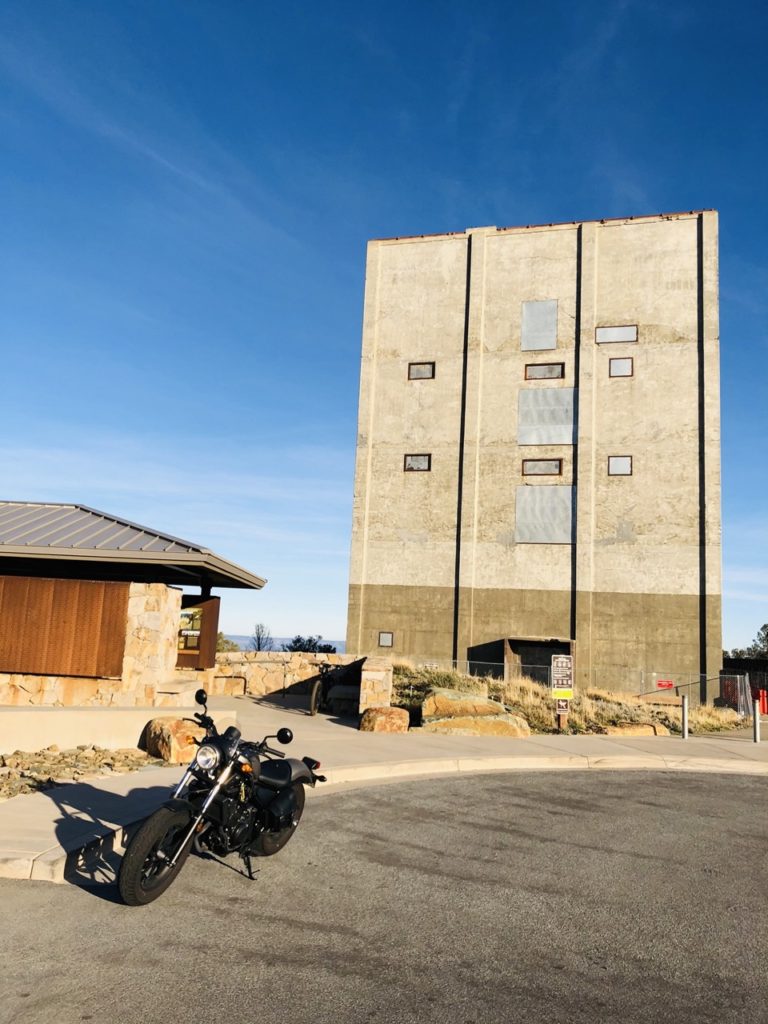
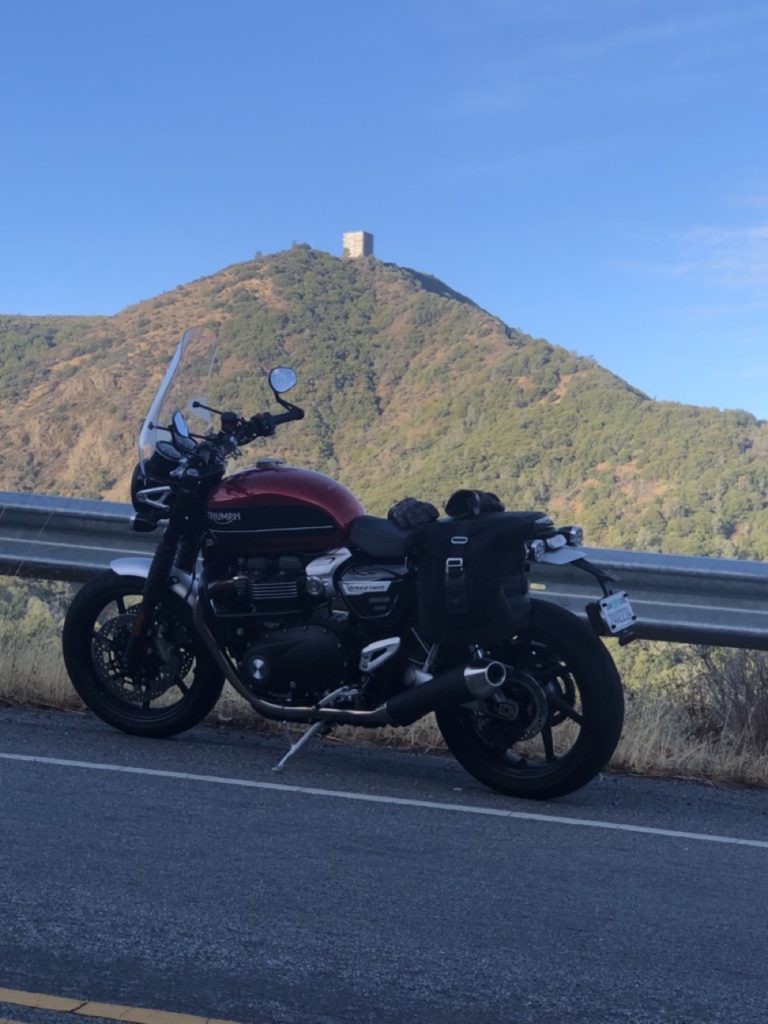
If you saw a windowless concrete eight-story cuboid building perched improbably atop a 3,500-foot mountain, like a sentinel against the clear blue sky, you must be looking at Mt Umunhum in the Santa Cruz mountains. The Cube is visible from miles away and this mountain was opened up to the public only in 2017, almost four decades after being decommissioned as part of a US Air Force station that housed about 125 airmen and their families in its heyday.

After riding east on Hicks Road from the town of Los Gatos into the Sierra Azul Open Space Preserve, I turn right and pick up Mt Umunhum Road to begin my ascent of the eponymous mountain. It’s early morning and I have the mountain almost to myself. The motorcycle leans eagerly around the curves, appearing to enjoy the cold mountain air and the light fog almost as much as its rider.

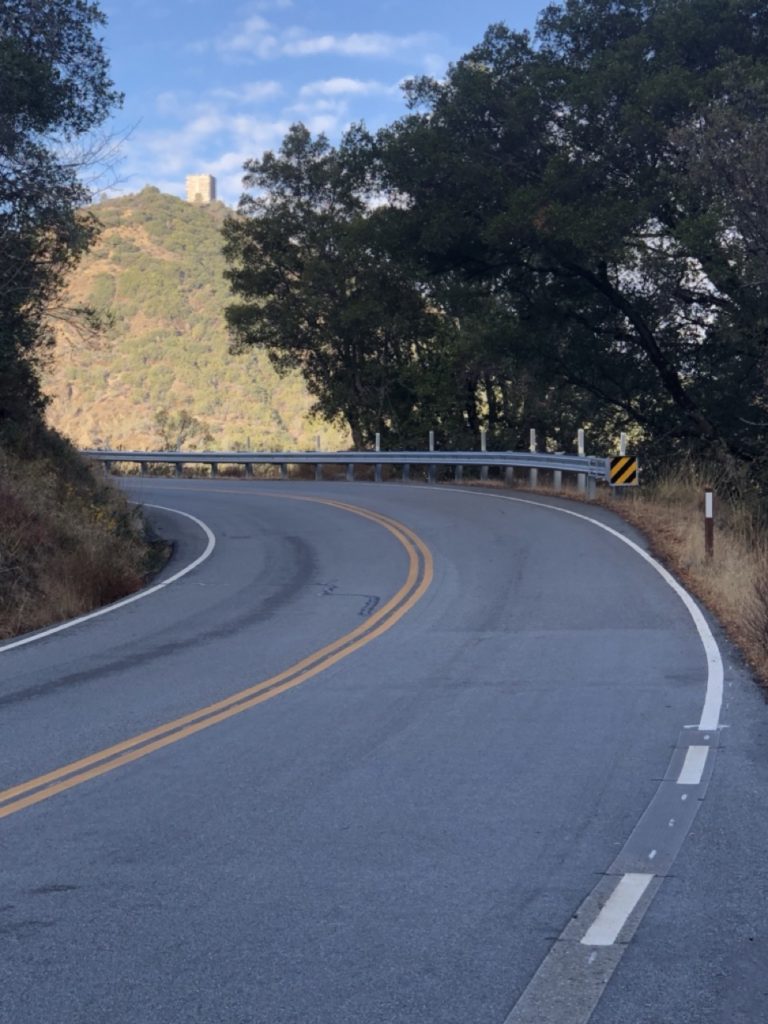
I stop at the Bald Mountain parking area to enjoy the views of the valley and the Almaden reservoir far below. As it swirls around the mountain, the road finds the gaps between trees to reveal occasional views of the bizarre mountaintop with its anomalous cube.

The cube was part of an early warning system set up in 1957, eight years after the Soviets had detonated their first atomic bomb and on the same year they would usher in the Cold War by putting an unremarkable two-foot metallic orb called Sputnik into low Earth orbit, and a mere three years before they would detonate the world’s most powerful thermonuclear device over Novaya Zemlya—deep within the Arctic Circle—that could have inflicted third-degree burns upon a hapless herder more than a hundred miles away, had he picked just that moment to step outside to milk his fondest reindeer for his morning coffee.

This unlikely mountain was called upon to do duty for our national defense, against unrelenting Soviet progress and military prowess. An 85-foot tall and 60-foot wide concrete fortress was erected and a massive red-and-white 150-foot sweeping radar hoisted above to scan the foreboding western skies—five times a minute—anxiously looking for the first signs of the cataclysmic Red menace.

Meanwhile, the folks in the towns of Los Gatos and San Jose lived through the hedonistic Sixties reassured that their skies above were keenly watched while they partied below, even as their radios would bleep five times a minute and put a lousy dent on their Jimi Hendrix Experience!

There’s something surprisingly asymmetrical when riding a motorcycle: cornering. Taking a right corner is always much harder than taking a left one. When you ride on the right side of the road and prepare to take a left turn, your eyes can see further, and through the turn, because of the space afforded by the oncoming lane on your left. By picking the line early and making use of the full width of the road, a rider can execute left turns precisely, even if the corner tightens up faster than expected.

Right turns can be blind, since you cannot easily see through the corner while riding on the right side of the road, especially when a mountain side looms to your right. A mistake in judging a right turn can run the motorcycle wide enough to drift across the centerline and put it directly onto the path of oncoming vehicles. Right-handed riders might also be more inclined to rely on their right eye, which has a natural advantage on left turns but is almost useless on the right. Many motorcycle accidents happen on poorly-judged right turns.

Training your vision is essential to safe riding. You constantly watch the road surface for surprises conniving to unseat you. You must consciously look where you want to go and this can be quite disconcerting when cornering, for you must turn your head and almost look over your shoulder and through the corner to the far end of the curve, trusting your peripheral vision to watch the road immediately ahead.

I park the bike at the top and walk up to the unsightly cube that hides a dazzling—almost 360 degree—view of Silicon Valley, the mountains across the bay, and the dark ocean to the west.

As I walk around, I imagine a young bored Cold War airman in brown camouflages sitting inside that concrete cage in front of a deeply recessed green terminal with a fat click-etty keyboard, a smoldering filterless Camel with an inch-long-ash-tip dangling precipitously from the corner of his mouth. A half-eaten ham sandwich sits on a well-thumbed issue of Playboy on his desk as he languidly watches for that one sinister ping that would metamorphose into a squadron of long range Tu-95 Soviet bombers (NATO codename, “Bear”) carrying atomic bombs that would ruthlessly take out San Francisco, LA, Seattle, and Chicago in one single scorching orchestrated first-mover attack, sending half the continent instantly up to Jesus and making Communism the religion for the world… once all the dust had settled and St Peter’s Gate had fallen off its tired hinges.

Our twenty-something airman’s only job was to stop all this before it actually happened. Since that terminal radar blip never came, he probably kept smoking them Camels and putting away ham sandwiches until one day the bosses put him out to pasture down the mountain, so they might bring up a fresh set of keen eyes that would lock on to that unremitting green radar screen inside the blue darkness of the whopping concrete bunker… and take possession of the raggedy Playboy.

I ride back, mindful to avoid using the rear brakes going downhill, given the lighter load that drops the traction of the rear tire. I get back onto Hicks Road and continue to the town of Old Almaden.

Old Almaden was a mercury mine, the first of any kind in California, that had started operating even before the Gold Rush. It was named after Almaden in Spain, the world’s largest and most productive quicksilver mine and lived up to its christening by becoming the world’s second largest, producing over 70 million dollars of quicksilver over its lifetime—a fortune unmatched even by any gold mine in the state.

The earliest miners from Mexico and Spain were followed by English miners from Cornwall, with a history of mining going back to the Bronze Age. Later, Chinese immigrants worked the mines, the kitchen, and the laundry. New Almaden developed a Spanishtown and an Englishtown, but curiously no Chinatown. That San Jose had five, may have had something to do with it.

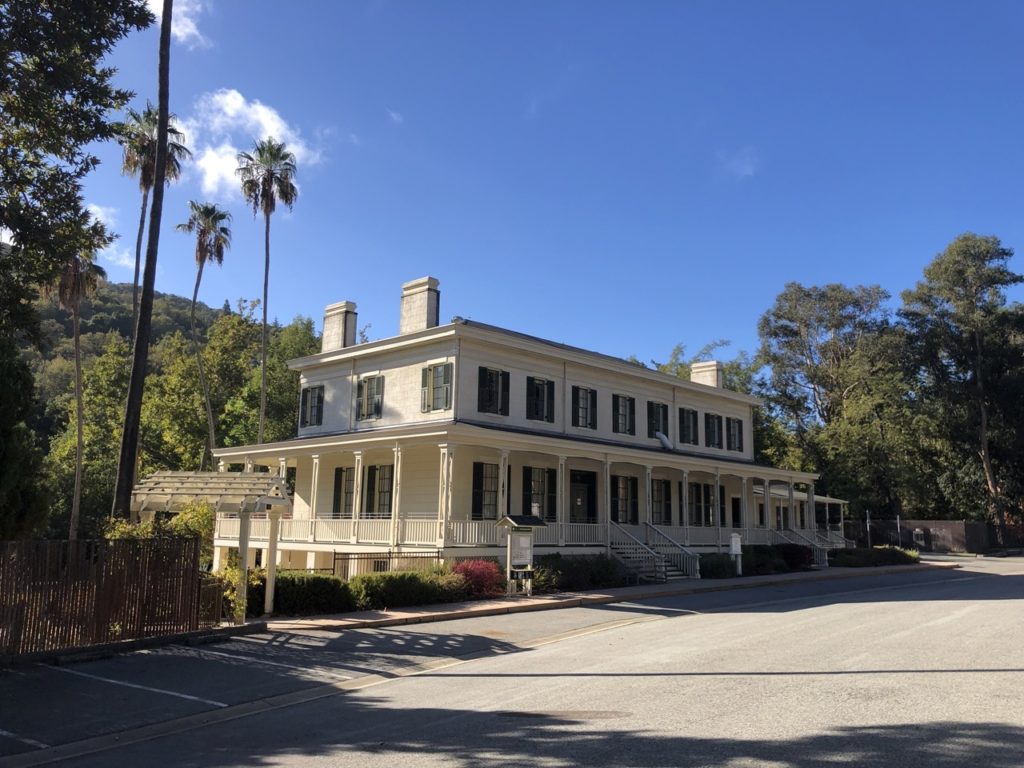
I pull into the grounds of the stately Casa Grande, a three-story brick, adobe, and wood structure, that was the palatial residence of the mine’s manager and is now a mining museum. It is closed, so I walk through a small gazebo by the side of the building to gaze at the landscaped gardens behind.

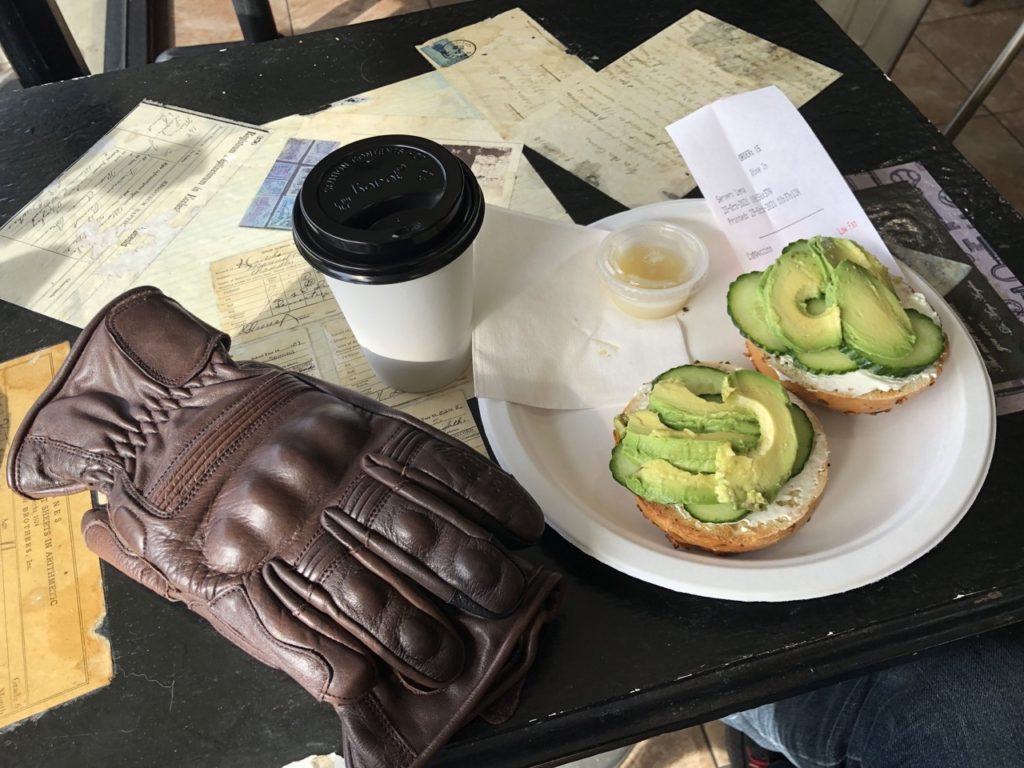
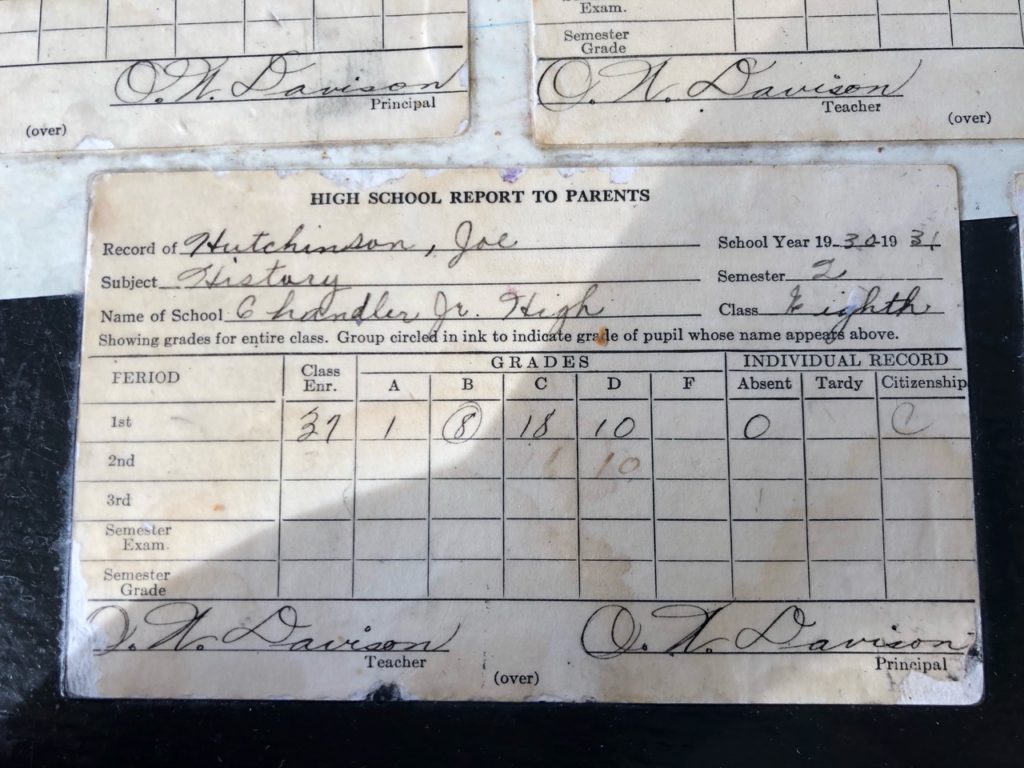
On my ride back, I stop for breakfast at the Blvd Cafe in San Jose. Working on a bagel with cream cheese and avocado, a laminated faded grade school report embossed on my tabletop catches my eye. It’s for Joe Hutchinson from Chandler Junior High—one of just eight students to secure a B in History in his eight grade class of thirty seven students.

The year?—1930! I wonder what ever happened to that studious Depression-era kid.

April 3, 2022

Coffee and Surf

When the menu flaunts four types of avocado toasts including one that combines pickled red onions with creamy almond butter that you can wash down with lavender or honey bee latte, you’re probably in a California cafe. Should faces with beards and nose rings outnumber wrists with Apple watches, you’re not in Silicon Valley. If the dude behind you in the line is nestling an eight or nine-foot surfboard in bronzed arms emblazoned with a deep blue tattoo that continues under his hooded shirt before emerging on the other side to complete the picture, you’re in Santa Cruz, baby!

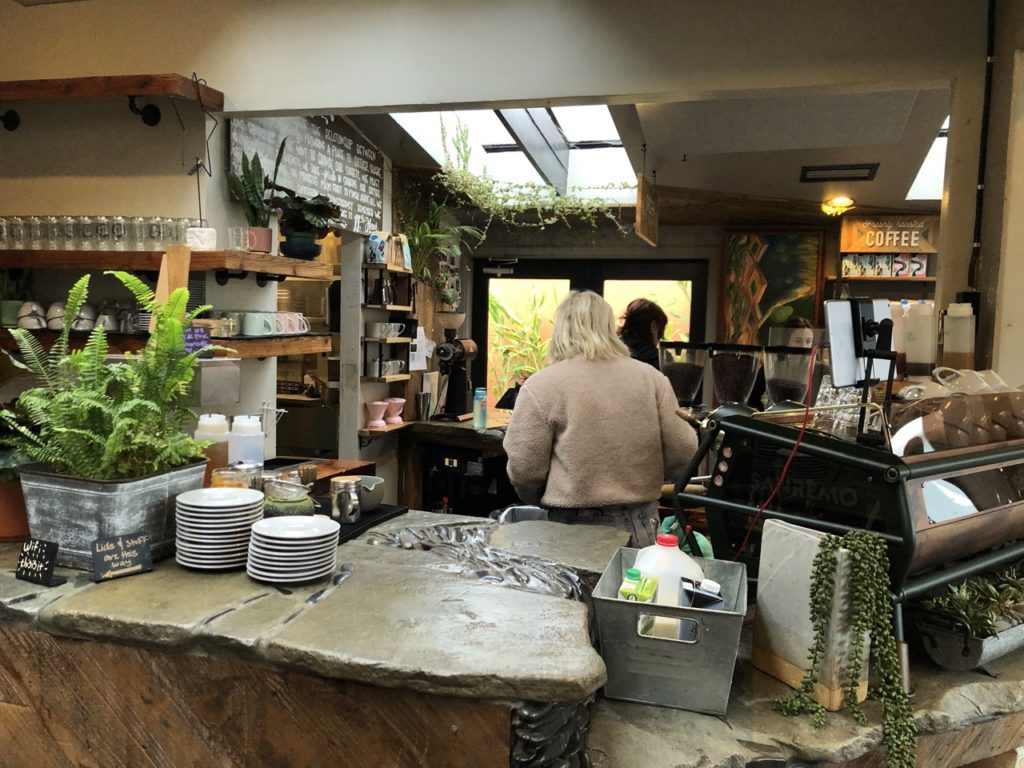
It’s eight in the morning at the 11th Hour Cafe in downtown Santa Cruz and yes!… I order an avocado toast along with a merely plain coffee and set up by the entrance on a bar stool against a polished pine-slab tabletop—just where I can see the patrons as they wander in and order at the all-girls counter, before getting situated. Which they can with plenty of options, for this cafe has seating everywhere: outdoors at the front, where a woman in a green shawl and absurdly tall platform slippers sips her coffee above a golden retriever that waits calmly at her feet, a massive snout resting on broad paws; a large room out back with wooden tables and chairs and a few sofas; and even an outside patio. But we aren’t done.

There’s a coffee roastery at the back, a dimly-lit full bar with high-gloss dark wood veneer that looks primped for an evening act, and store merchandise all over that includes t-shirts, hoodies, ceramic mugs, and assorted coffee gear. Potted green cacti and ferns sprout randomly, like mold on a bread slice. An ancient wooden upright piano broods in a dark corner.

Early that Sunday morning, I had ridden down to the town of Los Gatos to take California Route 17 connecting San Jose with Santa Cruz, across the mountains. The road has few cars out this early but will be jam-packed by noon with families driving down to the beaches and further beyond into the towns around Monterey Bay, eager to be shocked out of their Covid stupors by the cool April mountain wind and the frigid Pacific water.

The highway weaves left and right, with sharp turns and teasing curves as it finds the easiest path through the mountains, like a river yearning for the ocean. Route 17 was built in the early part of the 20th century and was relaid after 1950 when the Lexington Reservoir was created, inundating the towns of Lexington and Alma through which the highway passed.

You notice things on a motorcycle that you never do when you have a roof over your head or pillars bisecting your eyes. The asphalt hurtles faster towards you, the trees loom higher even as the sun plays hide-and-seek behind them, and the wind buffets your head in an unabating reminder of true speed.

Yet you see more and everything looks a bit bigger when there’s no frame around it: hills, ravines, streams, cattle, and the smudged faces of little kids flattened up against car windows as you roar by and offer a friendly thumbs-up (with your left hand please, or you will kill the throttle!)

A motorcycle has multiple controls—a clutch, a hand brake, a foot brake, and gears—creating enough work for every limb to stay busy while coordinating closely, but no control is more important or underrated than the one under your right wrist—the throttle.

A smooth ride has everything to do with a smooth throttle. Rolling off the throttle closes the throttle control value that regulates the amount of air that gets into the engine. As the valve closes it creates a low pressure at the intake of the engine, making the cylinders have to work much harder to compress against a partial vacuum. This saps their energy, drops their power, and rapidly slows down the bike through engine braking. Meanwhile, the engine control unit (or ECU) that constantly monitors the throttle position sensor and a host of other sensors, has already instructed the fuel injectors to starve the cylinders by cutting off their fuel.

Dropping a gear, further amplifies the braking by increasing the engine speed (rpm) even as fuel remains shut off. This creates even more resistance against the pumping action of the pistons which causes the bike to slow down yet further. Modern motorcycles have powerful high-compression engines that react rapidly to very small changes in the throttle.

The opposite happens when that right hand opens the throttle: the bike surges ahead, eager to pass everything. A throttle opened up at low speed with the clutch pulled in and suddenly let out, can deliver power so instantaneous that the forces can swing a bike around its center of gravity before the tires can bite into the ground, causing a wheelie where the front wheel lifts clear off the ground, like a bucking steer trying to lose its rider. A good rider can cross mountains by just controlling the throttle and without ever touching the brakes, if only he could check the juvenile enthusiasm of his fidgety right hand.

I’m betting that Hollywood tough guy, Will Smith—he with that twitchy right arm—wouldn’t be the one to do it.

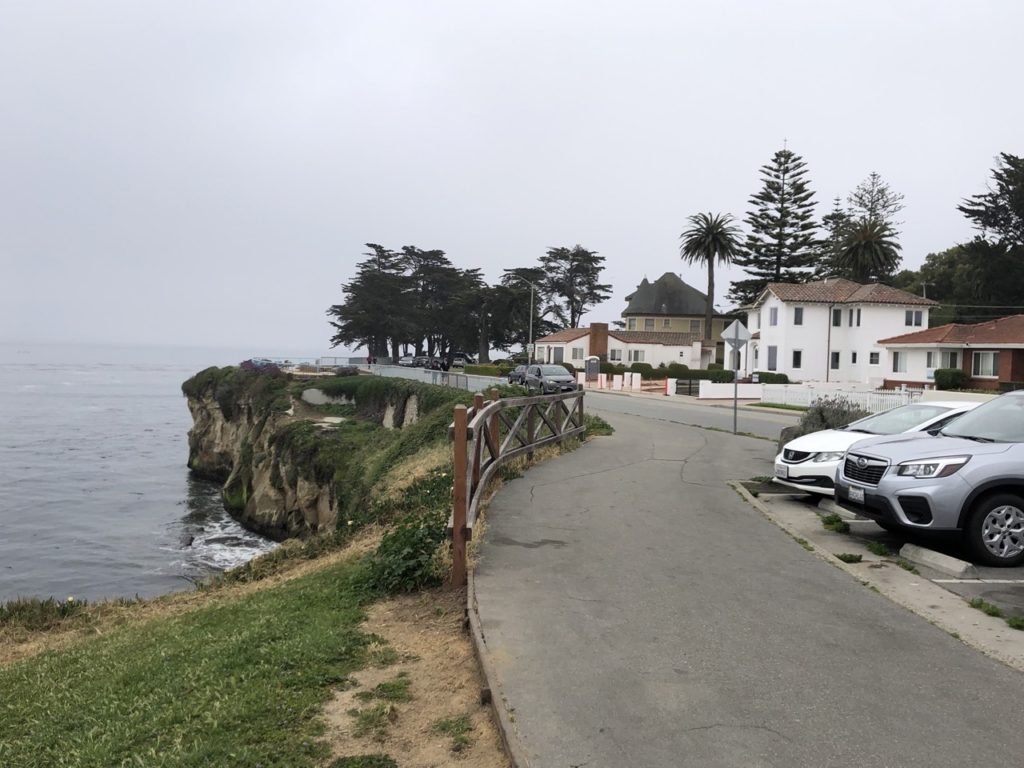
I leave the cafe late morning and ride down towards the ocean looking for Beach Street, where I turn and climb up onto W Cliff Drive that ascends along the edge of a cliff, away from Cowell Beach below me.

To my left, the Santa Cruz wharf runs over eight hundred meters out into the open ocean, as the longest pier on the west coast. It hosts restaurants, gift shops, and wine-tasting salons above, and sea lions below, that rest in the wooden rafters and let everyone know. I pull up at the Lighthouse Field State Beach, at the tip of a broad promontory where the road starts to turn inwards again, park the bike, and walk over to the edge of the cliff above the water.

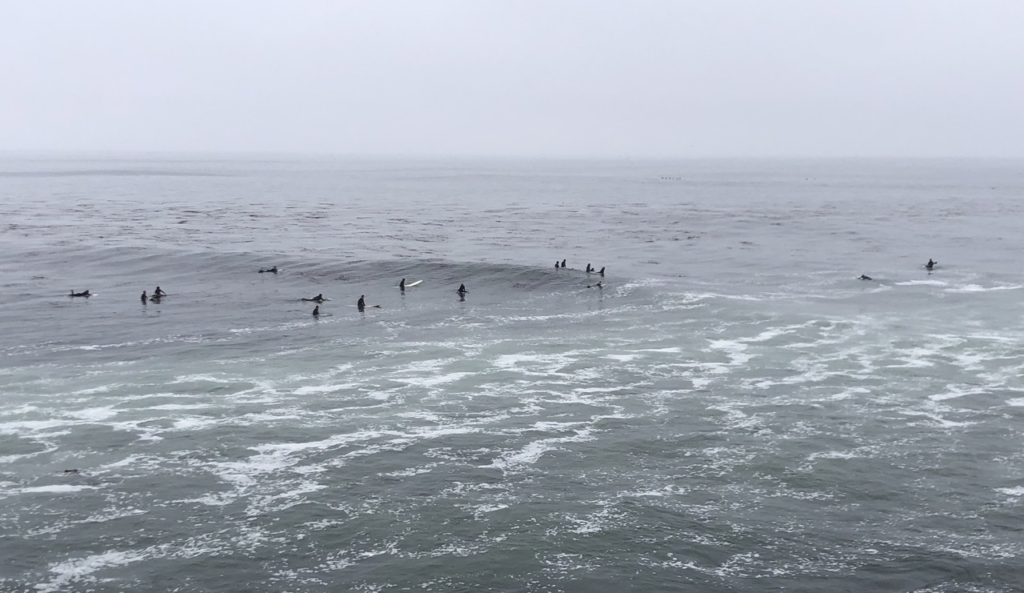
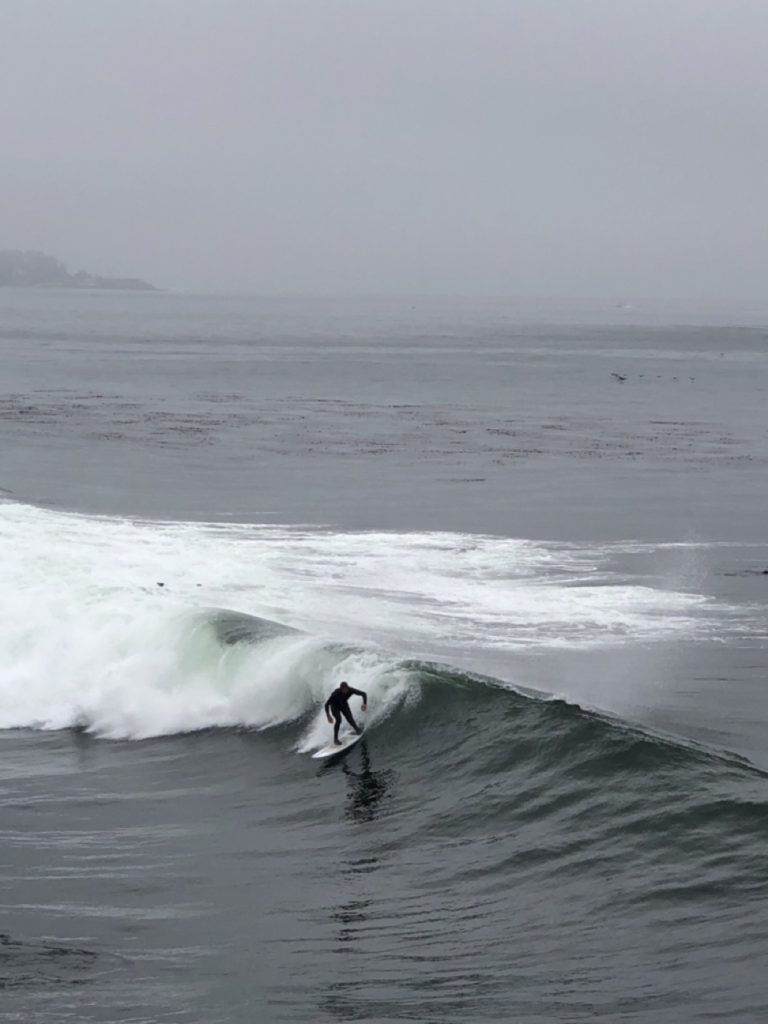
Below me, for hundreds of meters on either side are surfers—riding waves, paddling back to catch the next one, or simply resting atop the surging water to recover from their exertions. This is Steamer Lane, among the most famous surfing locations on the west coast and one of the best places to ride the quintessential North California wave. It has four zones running left to right that generate different waves and surfing experiences.

The wetsuit was invented here in the early 1950s and is often credited to Jack O’Neill—a body surfer and World War II navy pilot—although the inventor was more likely Hugh Bradner, a physicist from the University of California at Berkeley who arrived at this neoprene invention when he studied the problems encountered by frogmen in frigid waters.

I’m guessing male shrinkage wasn’t one of them.

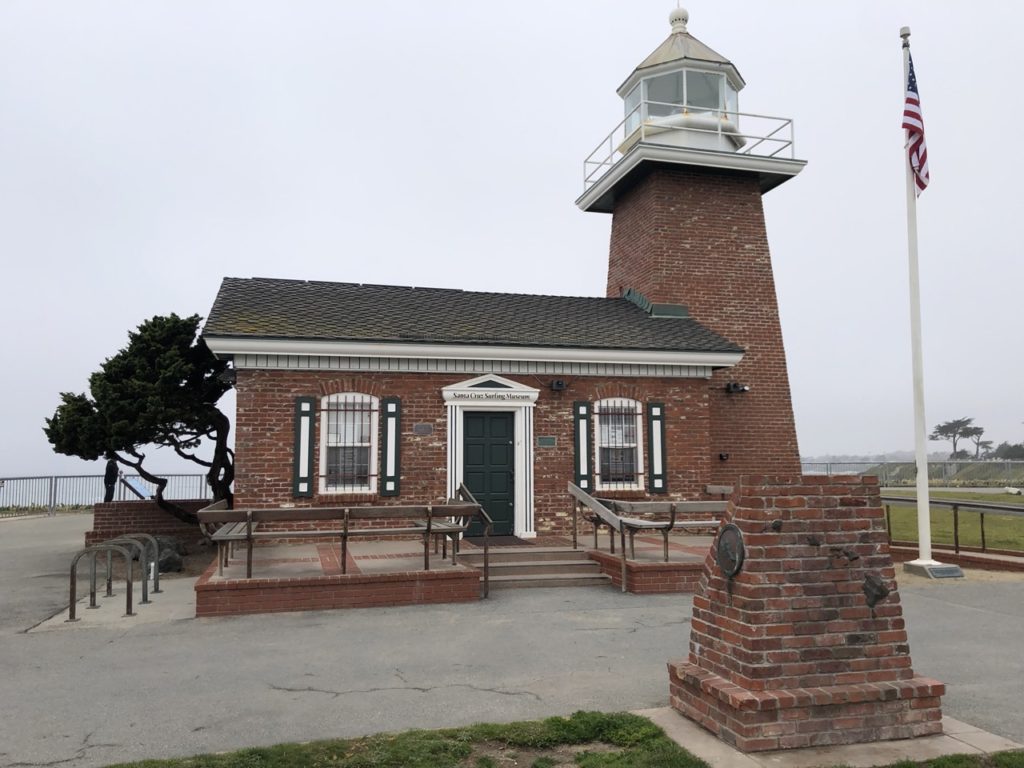
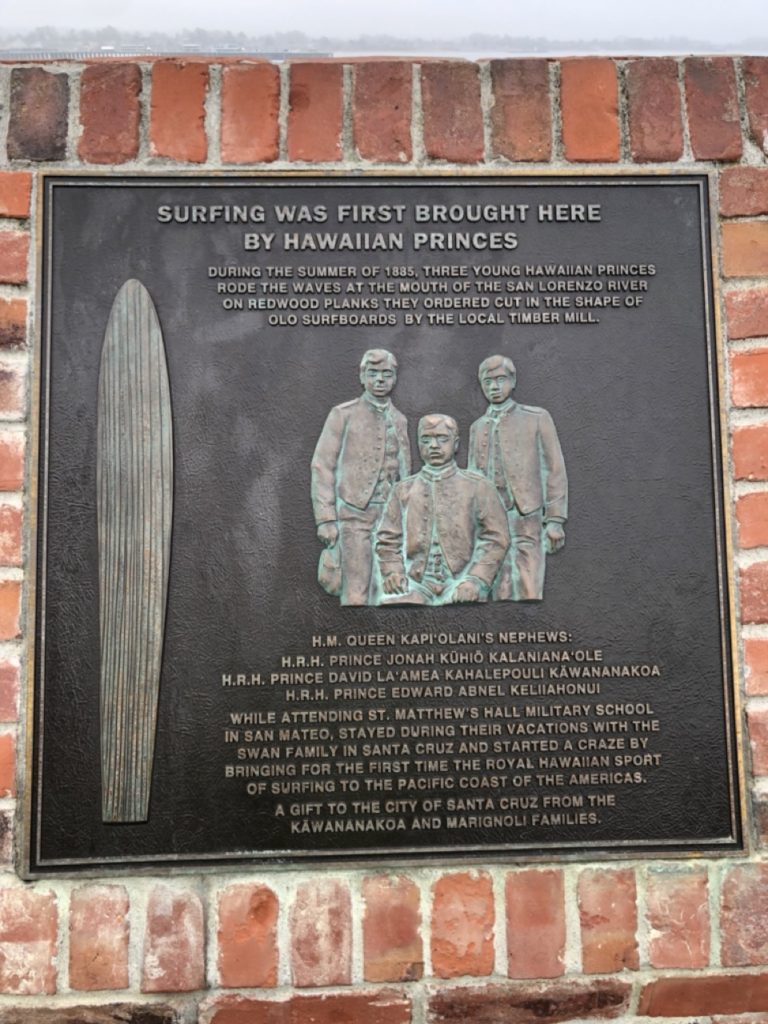
Surfing was brought to California in 1885 by three Hawaiian princes who rode the Santa Cruz waves on surfboards crafted with Santa Cruz redwood. Surfing likely originated in the south Polynesian islands before it made its way to Hawaii and consumed its idle and bucolic royalty. I walk by the Surfing Museum where a plaque illustrates the story. The brothers took their original surfboards back to Hawaii. More than a hundred years later, in 2015, the boards were brought back to Santa Cruz for a historic visit.

I start up the Triumph and ride across town—past gas stations, Mexican restaurants, Chinese takeouts, closed real estate offices and art studios, to get back onto highway 17.

Miles later a white Ferrari screams past, doing at least thirty miles over the speed limit as it swings around in a wide curve. I can proudly tell you that my right arm didn’t even twitch.

December 12, 2021

Indian Street Food and Harley Sound

Sometimes you need a good reason to throw a leg over a motorcycle and plot a course. A jaunt to a food truck is one such reason. So on a cold evening, I set out on a ride to find a food truck that would serve up chaat. My Apple map shows at least four, so I pick one and ride several miles on the Lawrence Expressway that runs for a couple of miles at a time, between each set of lights—just perfect for cafe racers. 

Cafe racing was a motorcycle subculture that evolved in the early sixties in Britain where rebellious rockabillies raced custom bikes—lightened up with chopped-off fenders and fitted with swept-back pipes and conical megaphone mufflers—between the droopy traffic lights of London. And yes, Triumph motorcycles were at the thick of it.

I turn into Homestead Road and pull up just under a mile from the one-mile circular spaceship headquarters of the most valuable company in the world and about two miles from Homestead High that graduated its iconic founder and most famous student, Steve Jobs. 

At the corner of a convenience store lot, a food truck bears stripes that proudly make up the colors of the Indian flag and stands in the shady swath of a sleepy willow. New Delhi Chaat is its promise and I stop at the counter to check things out. 

A helpful young lady listens patiently as I succumb to the lure of the menu and change my mind several times, even as I remind myself that chaat always renders my eyes bigger than my belly. Payment must be made inside the store, so I step in to hand my card over to the cashier.

We start talking and I find out that he's a Pashtun from the northwestern Pakistani city of Peshawar—due east of the Khyber Pass on the ancient Silk Road connecting East and West and the conduit for over two millennia of invasions into the Indian subcontinent—from Greeks, Persians, and Turkic-Mongols. Britannia, of course, ruled the waves and took the sea route!

The cashier spoke Pashto and Urdu, unlike his Afghani blood-brothers across the border who speak Pashto and Dari. We talk cricket and that invariably leads to World Cup winning cricket captain and current Prime Minister of Pakistan, Imran Khan, also a Pashtun.

I walk back out and the girl offers me a hot masala chai—on the house. I clutch it for warmth and watch a Hindi movie playing on a TV screen mounted at the side of the food truck that aims to keep a customer's eyes as busy as their jaws.

I look at the menu again as I wait for my takeout and the dahi batata puri catches my attention. A gear clicks in my brain as I realize I have the perfect way to explain the distinctive sound of a Harley Davidson motor. Here's how it goes.

b-a-T-a-T-a! 

Say that aloud. Go loud on the Ts and stay soft on the As and the B. Try it again and listen to yourself as you speed it up. 

Congratulations! You are now mimicking a four-stroke Harley V-twin engine. 

The aural magic comes from irregular timing: the second T quickly follows the first and there's a gap before it starts over again. That's exactly how Harley twin cylinders fire: unevenly.

The staccato you hear from any motorcycle engine is actually a series of sonic pops that come from puffs of exhaust gas as they get squirted out of the combustion chamber at the end of each cycle. This is the T in the baTaTa. When the pops are evenly spaced, you're listening to a common motorcycle; when they're uneven, you're losing your hearing to a thundering Harley. 

If you have trouble visualizing a piston engine, look no further than down your leg. Imagine riding a bicycle, standing up. Your thigh is the piston and it reciprocates by going up and down. Your knee is the wristpin that turns this into rotary motion and your shank is the connecting rod that delivers this turning motion to the pedal. The pedal spins a crank which drives a chain to rotate the rear wheel. That's exactly how a motorcycle works. 

The difference of course is the power. Since you'd rather slurp dahi batata puri than sip octane, you're condemned to deliver puny human-power, instead of brawny horsepower.

Your legs are also constrained to work so that one thigh goes up when the other goes down, since they are connected to diametrically opposing pedals. A two-cylinder motorcycle engine does not suffer this constraint since each piston is connected separately to the crankshaft that it can independently turn (using its own crankpin). However, they are usually timed to be opposed—when one piston is at the top, the other is at the bottom—to keep forces balanced, vibration minimized, and the rider's gonads intact. 

The pistons in a Harley Davidson V-twin have 45-degrees between them and connect into a single crankpin (imagine a single pedal on your bicycle for both legs), so they are constrained to move together in a manner that one cannot be fully up when the other is fully down. So one cylinder fires shortly after the other and they both wait restively for a while until the next cycle. 

It is this drama that sends baTaTa pops into your ears and rastaman vibrations into your pants. 

That's the Harley way! Just have your children early.


October 24, 2021

An Observatory Called Lick

This story starts with the improbable James Lick who was born in Pennsylvania in the early 19th century and chased every boy's dream of becoming a piano-maker, in the manner a boy today might want to become a YouTuber: by just doing it. 

Lore has it that he didn't stop there and was tickling something more than mere piano ivories, for he got a mill owner's daughter pregnant and received such a sound thrashing for his impetuosity that it forced him to bail out of the country of his birth and take his skills to the place where his pianos were being bought in large numbers: Buenos Aires. 

Escaping Portuguese imprisonment while returning from a trip to Europe, Lick moved his craft to Chile and then onto Peru to escape political disfavor, before leaving once again to complete an epic arc around the Americas, moving for the last time—along with his piano tools, thirty thousand dollars in gold, and six hundred pounds of Peruvian chocolate—to the little port town of Yerba Buena that would soon change its name: San Francisco. 

Lick was known to be a surly man but his chocolates went over so well with the gold rushers that he decided to open up this opportunity to his buddy back in Lima: Domenico.

That chocolatier Domenico—like his fellow Genoese Christopher Columbus more than three hundred years prior—had similarly set sail across the Atlantic, but with the more prosaic intent of setting up a coffee-and-chocolate business in Uruguay rather than discovering India, before moving that business to Peru and now, responding to Lick's scrupulous market research and audacious proposition, moving it once again along that same epic arc across the Americas that would end up in that town of several hundred by the Golden Gate, where he installed his fledgling chocolate business and bestowed it with his last name: Ghiradelli.

But let's not lose track of the prescient Lick who started buying real estate in that small rechristened town that grew twentyfold in two years when the gold rush really hit, only to double down by entering the hotel business and setting up Lick House on Montgomery Street—the best hotel west of the Mississippi until it would be consumed by the big earthquake of 1906—and then buying even more land far down where his ambitions grew, even as the peninsula ended: San Jose.

Laid down by a stroke and presumably wreaked with introspection, Lick spent his last three years considering how he might spend his considerable fortune, giving up the idea of erecting a pyramid in his own honor in San Francisco that would be larger that the Great Pyramid of Giza and opting instead to fund a mountaintop observatory with the largest telescope ever built by man, that would be installed in his name atop the tallest mountain in the entire bay area: Mount Hamilton.

So what has all this to do—you may rightfully ask—with what you came here to read: Motorcycle monologues?

Well, the Lick Observatory is my destination and I leave early in the morning so I might ride across the entire city of San Jose in minimal traffic before joining up with the serpentine route 130, constructed exactly over the same track laid down almost a century and a half ago to convey building materials, cement, and presumably large refracting telescope parts across twenty miles and three hundred and sixty five curves and switchbacks, but with a slope never exceeding six degrees so it may comfortably be ascended with the best propulsion of the time: Horses.

My ride today is tougher than usual, the challenge having less to do with the terrain and more with the punishment meted out by the rising sun that flashes sharply and unexpectedly between the countless turns and tall trees on the mountain road, taunting my vision and rendering futile my sunglasses and visor, for my ride this morning—unlike recent others—has put me in a new direction: East.

Pointing the motorcycle at the large white dome of James Lick's largesse, I reach the summit a bit before nine, park the bike under the Olde Astronomers Dining Hall and dismount with that urgent singular intent that yearns for privacy, only to spot a lone cyclist rubbing his hands to bring some warmth into the cold morning and gently shifting his feet with that powerful suggestion of identical intent, before he looks at me to allow our eyes to confirm exactly what our bodies seek: a Bathroom.

There are many households at the summit for the astronomers doing duty, with explicit signs reminding visitors to lower their tones but not their zippers, for daytime is when their denizens sleep and the neighborhood is where their children play, when they are not attending that single-roomed institution that shuttered as recently as 2005, after operating for well over a century: The Mount Hamilton School.

The steep driveway to the observatory is blocked off by a locked gate that will only open at noon and just as I accept the utter disappointment of that last-mile denial and prepare to dolefully ride back down the mountain, a staffer appears in a white pickup truck and warmly agrees to open up the gates, allowing the two of us to ride up to use the bathrooms and soak up the spectacular views that—on a clear day like this one—can sweep 270 degrees counterclockwise from due north to due east: Mount Diablo to Yosemite National Park, arcing through the valley of Silicon.

A dozen riders wearing blue Viet Cycling Team jerseys arrive red-faced and panting at the end of the unrelenting six-degree climb to the summit that has taken them almost three hours from the crack of dawn and I chat with a few of them and take some group photos while getting recommendations for restaurants in Vietnam Town in San Jose—the city with more Vietnamese residents than any outside Vietnam—where I plan to stop for my favorite type of sandwich: Banh Mi.

About an hour's ride later, I stare down at a long banh mi that starts with a baguette derived from that country's French colonial past and stuffs it with tofu, mushrooms and avocado instead of Vietnamese pork, as a concession to veg-friendly California, then adds cucumber slices, coriander, pickled radish and carrots in a spicy chili sauce to deliver that perfect amalgam of western bread filled with eastern zing, that I now send down with sips of plain water, for I have declined that thick brew where an ultra-bitter decoction would feud in my palate with super-sweet condensed milk: Vietnamese coffee.

October 10, 2021

The Fame and Infamy of La Honda

The Younger Gang—outlaws and co-conspirators of the infamous Jesse James—once hid out here, presumably with their stash. Ken Kesey and his Merry Pranksters lived communally in a redwood cabin here where they held their light-and-sound psychedelic LSD-fueled parties, seeking to expand the consciousness of mankind. Tom Wolfe's The Electric Kool-Aid Acid Test—chronicle of the roots of the hippie movement and among the best-cited works of the New Journalism style—got its raw material here. The Grateful Dead played here. Which means the Hell's Angels rode in on their thundering motorcycles. Hunter Thompson and Neil Young lived here too.

I'm in La Honda—a tiny forgotten mountain town with less than a thousand residents—that I reach around nine on a recent morning. The ride, along Alpine Road, winds west for many miles over long stretches of frequent tight turns through nature preserves and creeks, leaving the motorcycle raucous and impatient in second gear. 

At low gear and speed, a motorcycle gets hot very quickly and will dutifully let your legs know. Early motorcycle engines were air-cooled and depended on metal fins around the cylinders to stick out into the airflow to give up their heat. Then liquid cooling came along using water's superior thermal properties over metal to soak up engine heat. But liquid cooling needs a big radiator up front to dissipate heat from the water itself and that mucks with the aesthetics of motorcycle minimalism. It is for this reason that most Harleys are still air-cooled even as their riders atop are willfully slow-cooked, like the frog in the fable. Harleys also persist with V-twin layouts that puts one unlucky cylinder at the rear and in the hot slipstream of its happier twin ahead. 

Bad science! Bitchin' sound!

I stop at the La Honda Market—the town's only store—with supplies, beverages, and a sandwich counter that looks barren. A man in a blue plaid shirt takes my money and points to the large coffee carafe. 

Tiny 50 oz. bottles of Jack Daniels and Smirnoff stand tidily against each other like soldiers in a parade, ready to move for $2.99 each. A framed old poster on the wall offers a $500 award: 

Wanted Notorious Outlaw—Belle Starr. 

Belle Starr was a rare woman outlaw from the post Civil War period and an associate of many of the notorious Missouri-born criminals, including the Younger Brothers who had moved to La Honda. But she must have lacked their keen bloodlust, for the poster warns us thus: 


"Though not a killer she is known to carry two Pistols and has a reputation for being a Crack Shot!"  

Shot to death at the age of forty-one, Belle Starr lives on in many movies, books, and songs from musicians like Woody Guthrie and Mark Knopfler.

I take my coffee to the small porch outside and settle down on one of the tables overlooking the road. The coffee lid frustratingly lacks an air vent and the enjoyment from the beverage is rudely annulled by my constant anxiety from trying to get at the coffee while fighting a possible spill at every sip. Tired of fighting nature's abhorrence of a damn vacuum, I finally remove the lid and throw it away.

A cyclist pulls up, leans his bike against the rail, and goes in. Two large water bottles sit on the triangular bike frame, like V-twins on a Harley. He comes out with a sandwich and I find a way to start up a conversation. Turns out that he's on an 85-mile bike ride today that will take him across the mountains, to the beach and then back again—which I believe might partially explain why he didn't come out brandishing one or more of them 50 oz. bottles for two-ninetynine apiece. But he makes me curious about the fuel requirements for his arduous trip and so I ask him what he's eating. 

"Ham and cheese is what I usually get, but they are out of it today. Don't know what this one is," he says as he peels back the wrap and digs in. Small semicircular cutouts appear rapidly on the round fat bun that soon disappears. 

We leave together and I'm happy to be the one on the motored bike. He slips his feet into clipless pedals to become one with his bicycle, waves and rides away with striking ease.

I cross the street and walk over to the rustic shack diagonally across. This is Apple Jack's—a roadhouse and watering hole—that has quenched bandits, horsemen, stagecoach travelers, beatniks, bikers, hikers and techies, over 142 years. The facade wears an exhausted droop and the tall redwoods that surround and dwarf it appear to have taken over the responsibility to prop the place up and keep it standing. The saloon still comes alive every weekend with live blues, rock, and country music that floats around, adding bounce to the dusty feet dancing away on the creaky floorboards, before wafting down the mountains and dissipating into the valleys.

I get back on the bike and ride down a narrow side road looking for Ken Kesey's restored cabin, but can't find it. Kesey was supposed to have written parts of One Flew Over the Cuckoo's Nest, his first novel, on the bathroom walls and I wonder if they might have been preserved. The road ends at a trailhead leading to the newly created La Honda Creek Preserve and I disappointedly turn the motorcycle around and ride back out. 

I head out north for a few miles on highway 84 to get to the junction with highway 35, marked by the iconic Alice's Restaurant—a building from the early 1900s that was turned into a restaurant in the 50s and proclaims to be "little slice of bliss among the redwoods". Motorcycles and low-slung sports cars fill the irregular lot in the middle of the four-way junction that it occupies. A single retro gas pump with an analog readout gurgles away, in stark contrast with a biker in a mod red-and-white leather suit fueling his fiery red Ducati. 

I turn south onto Skyline Drive and follow the road over the ridge of the mountains for about fifteen miles, before descending down in a flurry of bends.


September 26, 2021

Newts and Ghost Towns

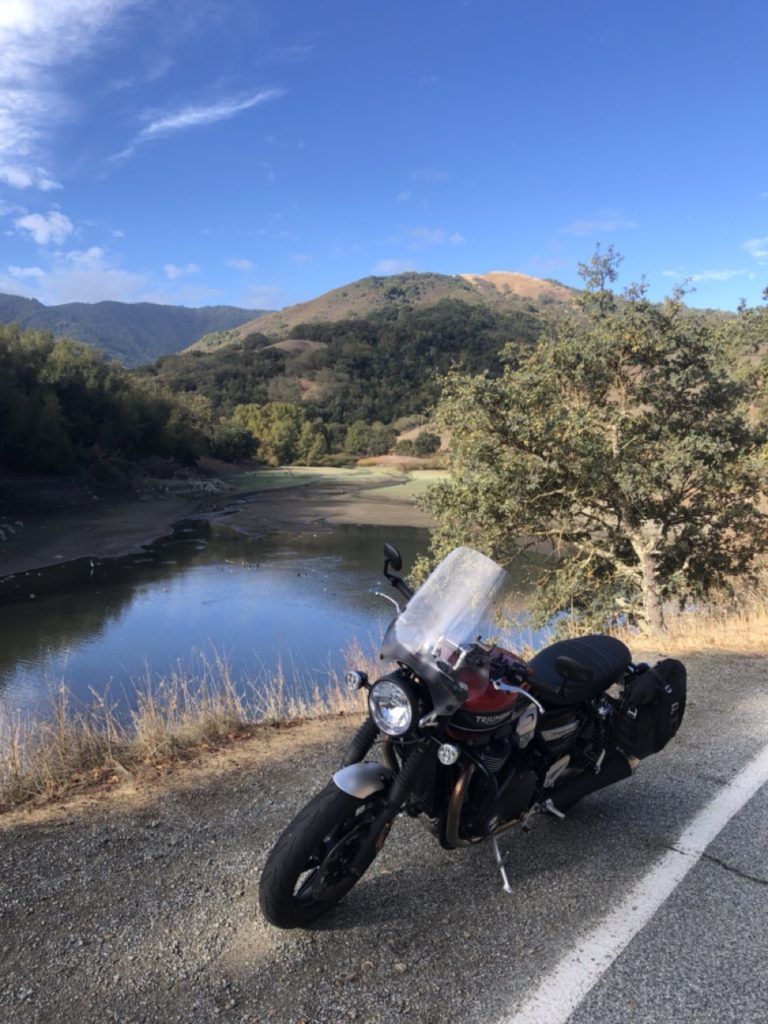
This morning's ride takes me around the Lexington Reservoir, a few miles from Los Gatos. The Alma Bridge Road runs completely around this waterbody, creeping around its nooks and crannies as it passes trailheads and overlooks. I stop nostalgically by the boathouse of the Los Gatos Rowing Club where my daughter used to row, to look over at the teams pulling furiously in the water.

Lexington Reservoir was created in the early 1950s by damming the Los Gatos Creek in an attempt to replenish the groundwater depleted by the expanding orchards in the county. The reservoir submerged the two towns of Lexington and Alma that had grown to support travel—first by stagecoach and then by railroad—across the mountains to Santa Cruz. 

Lexington was a halfway stop for stagecoaches to take on two extra horses to get over the treacherous mountains and was best known for the grisly 1883 murder of an elderly resident to get at his stashed gold. Gentler Alma ran a large hostel for travelers that amicably served grizzly bear meat.

Since remnants of the ghost towns may still be seen today when water levels are really low, I stop and observe a few times but only see water, eroded banks, and the occasional driftwood bleached out by the sun. 

I pass a sign that reads: Newt Xing. Several species of newts (a type of salamander) are native to the area and come down from the hills in winter to breed in the water. This road cuts right through their migration path and thousands are run over each year. Newts have a lifespan of around fourteen years, long enough that an annual massacre could decimate a local population.

I recall The Ancestors Tale where noted evolutionary biologist Richard Dawkins presents the concept of a ring species—a connected series of neighboring populations, stretched around a ring, that can successfully interbreed with their neighbors, until you reach some part of the ring where genetic differences have accumulated sufficiently to make adjacent populations too distantly related to interbreed. I've always found this a breathtaking illustration—almost a proof—of evolution and speciation, that demonstrates across space what is usually enacted over time.

Dawkins had cited a certain species of California newts as an example of a ring species, leaving me wondering if the little guys that cross this road might be able to do it with their neighbors across the mountains.

Riding back though Los Gatos, I see the white tent roofs of the busy Farmers Market and decide to stop by and take a look. 

One of the nicest reasons to ride a motorcycle is the ease of finding parking spots. The bike takes up little space so you could just turn towards the street and back it in between two parked cars. Your exit remains easy. Not sure about the cars. Or you could just park in any no-parking red-zone area and no one really throws a fuming fit. 

Now there are two easy ways to squeeze some extra performance out of a motorcycle, short of turning yourself into a grease monkey and letting loose on the mechanicals. 

Fuel additives is one way. Should you look around, you will find plenty of products: octane boosters, enzyme fuel treatments, fuel system deep cleaners, and hydrocarbon boson actuators. OK, I made the last one up, but you get the idea. No! Higher octane gas does nothing for an engine, unless it is already pinging or knocking. Any engine with a specific compression ratio needs a minimum octane rating to prevent combustion before ignition, due to high compression and heat. Thus high compression engines sip high octane gas. But adding anything above what's asked is about as clever as dropping dollar bills directly into your tank and expecting escape velocity.

There are more scams to part bikers from their money than there are actual bikers. 

A second and simpler path to performance is to fuel up the rider and that's the one I take. I stop by the Mexican stall and stand in line to get a tamale. When asked, I spring for the spicy sauce which I assure you is worth at least one octane upgrade. I sit on a park bench and watch kids and dogs frolic in the morning sun. 

A cute family is sitting in front of me: a boy under two, along with his parents and a grandparent. I wave at the little fellow and despite his mother's encouragement, he doesn't wave back. He's wearing a tiny 49ers Future Draft Pick jersey, his father dons a red Joe Montana shirt, while his mother's got the hat. Like medieval knights, this family is wearing their fealty, although I must admit that from where I sat I couldn't tell what grandma had put on.

The original Forty Niners were lucky gold miners because time had sandwiched them between 1848 and 1850, two dates of considerable significance. The former marked the start of the California Gold Rush, while the latter marked the year California became a state and miners now had to contend with taxes and land rights. Thus the Niners were early enough to avoid competition and could simply stick a pan into a river bed and pull out gold that was theirs to keep.  

So when California got its football team almost a century later, it could have done far worse—than 49ers—to pick out a name that would confer good luck and ample fortune.

No Farmers Market is complete without a stand-up musician and I can hear him now. He's been moving easily across genres and periods. But he's also considerably off-pitch and had he not been standing still, I might have graciously pinned it on the Doppler effect. 

Earlier, he was doing Luis Fonsi's Despacito, then Billy Joel, and now he's singing an unlikely song that I recognize as Land Down Under by an 80s Aussie band called Men at Work. 

My brain associates songs with time and specific people. When I hear Billy Joel's You May be Right, I always think of Amar, my good friend and dorm neighbor, who depended on the Piano Man's tunes to get him through problems sets in structural mechanics. Land Down Under reminds me of quick-witted Murali, a hilarious college mate who played it incessantly and fatefully wound up teaching Down Under for some years. Despacito evokes my older daughter from her senior year at high school, improvising the piano.

I walk over to the musician's tent and see him accompanying himself on a guitar, while a tenor sax stands up on a floor stand. So that was him playing the sax too! Now that takes talent. I chide myself for my prior hasty judgment and drop a dollar into his donation box as a token of my contrition.

I stop by at Great Bear Coffee to get a cup of their proud roast and call it a morning.